

Essay IV: The Empty Throne
Sovereignty Without a Sovereign in the Constructed World

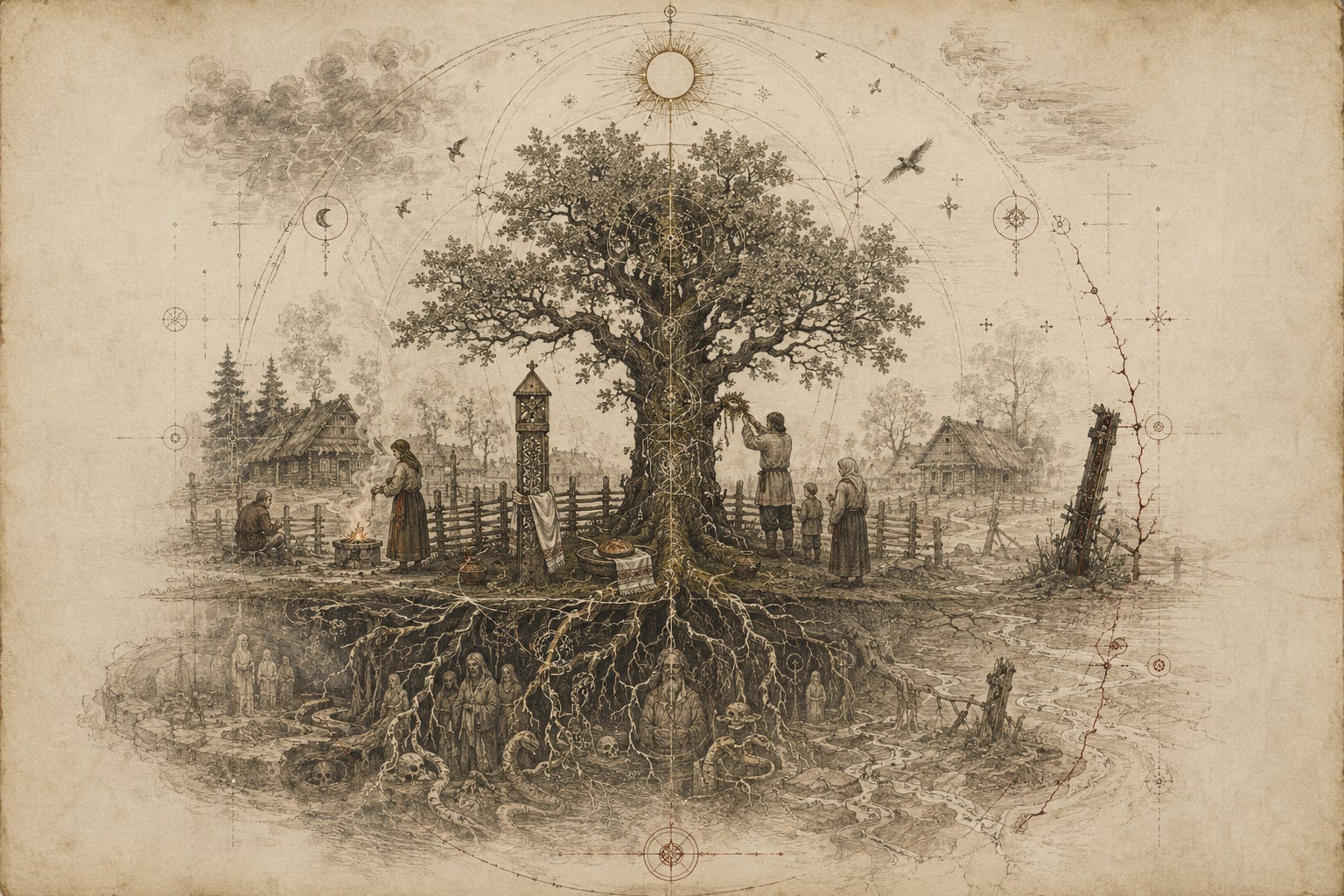
There is a kind of authority that does not descend.
Most political imaginations begin at the top. A god grants power to a king. A king delegates power to lords. Lords command soldiers who enforce the king’s will upon the land. The structure is vertical. The legitimacy flows downward. And the question that animates every political drama within such a system is always the same: who sits on the throne? Claim it, and you claim everything beneath it. Lose it, and everything beneath it is lost.
The world I am building does not work this way.
The previous essay argued that the Slavic divine order has no active sovereign, that the highest principle, Svarog or the unnamed Boh of the treaty formulae, has withdrawn from governance, leaving the active gods to maintain the cosmic order through complementary functions rather than hierarchical command. Perun does not rule the other gods. He holds the mechanism of obligation. Veles does not serve Perun. He completes the circuit from below. The divine order is a web of mutual dependence, not a pyramid of command.
This essay asks what that structure means for the humans who live within it. How does authority work when no god sits on the throne? How does a prince rule when he cannot claim that the highest power in the cosmos appointed him? And what happens, politically, practically, metaphysically, when the mechanisms that sustain authority in such a world begin to fail?
