



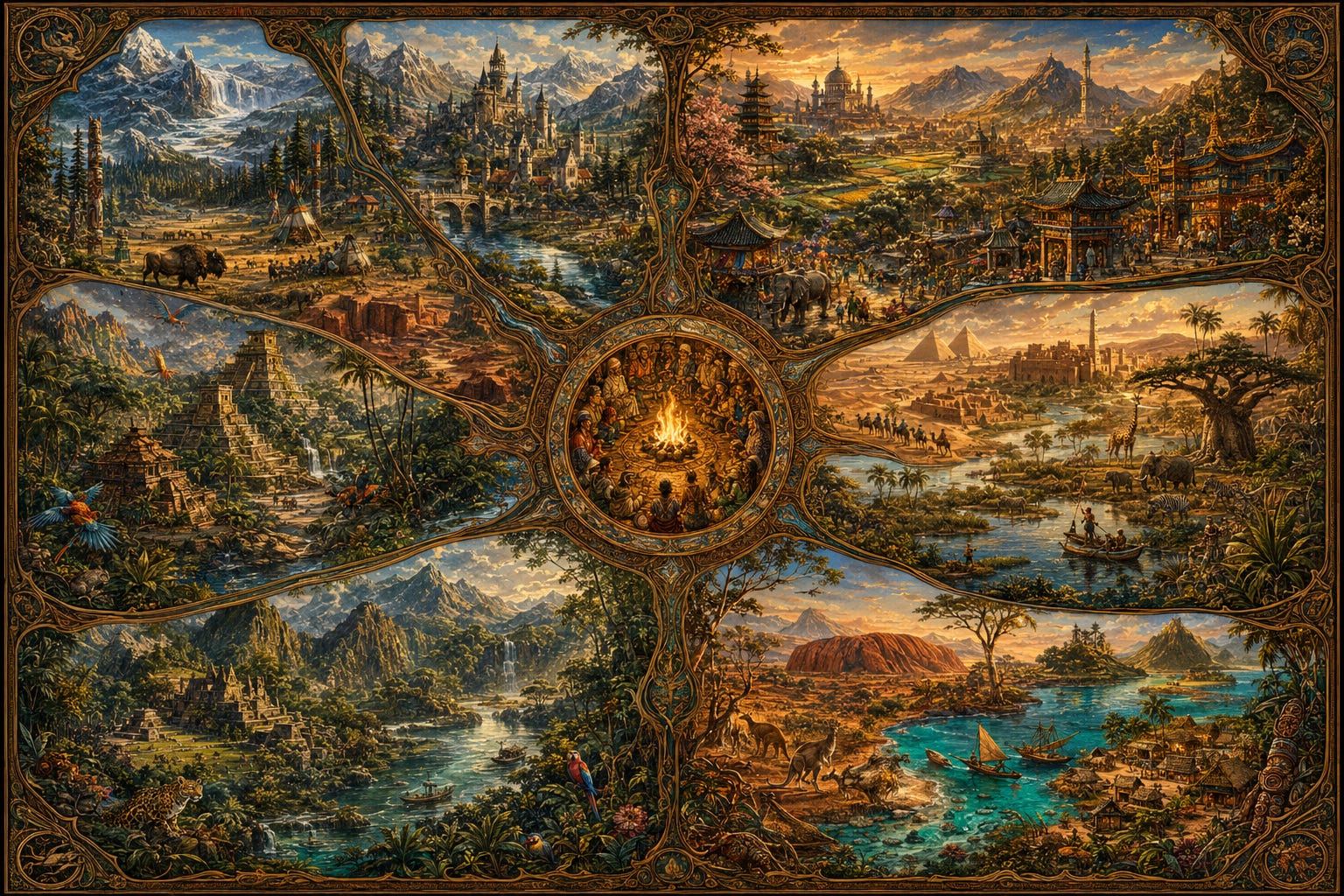
There’s nothing in life but stories. Told or untold, written or not, real or imagined, or maybe a dream — it’s all about stories.
Forgotten Tales is a home for the stories that are no longer told — the ones passed down in kitchens, courtyards, and temple grounds, in languages the wider world never learned to listen for. Each entry is a folktale, lullaby, or memory carried forward by the person who inherited it, published in its original language wherever possible. These are the tales vanishing not because they were banned, but because they simply stopped being told. This is a corner of the internet where the telling continues.
This one comes from Dear Manisha, in Haryana, India. The family were lying on cots in the courtyard, under a starry sky. Her younger sister, who could not sleep, asked their mother for a story. This is the one she told — recounted here from memory and carried out of Haryanvi, which has no script to be carried in.

Nirbhag
“There was once a king,” she started, as there’s always a king.
The king had two sons and a daughter (no mention of the queen).
From early childhood, every person seemed to call the girl differently. They called the princes “O Fortunate” and the princess “O Unfortunate.” The wise men, the scholars, the teachers, everyone.
When they called on any of the princes, they respectfully said, “O Fortunate, come here.” But to the girl, the teachers always said, “You unfortunate, come here.” The girl felt bad, but it was always like this. So one day, when she couldn’t take it anymore, she went crying to the king. She told him how everyone always treated her differently, calling her “unfortunate.” She asked him why it was like this.
The king was shocked and called his sons and asked about it. The boys also shared the same — they were the fortunate, and she was the unfortunate. The king had no answer. (I don’t remember if he asked the teachers or wise men, but if he did, they just probably said “because she is unfortunate.”)
So he did what every seeker did. All four of them went into the woods and beyond, to search for the answer. They went on and on, for days, for weeks, probably months, but still no answer.
One day, when they were tired and thirsty (and probably hungry), the king asked the prince to look for a water body or shelter. The prince climbed a tree, and far, far away, he saw a palace. They went on, with hope.
When they finally reached the palace, the king got off his horse and knocked. No answer. The princes came one by one and knocked. No answer. As tired and desperate as they were, they tried to push the door open. Nothing. All three of them tried to open it, to break it. Nothing.
Then the girl got off the horse and said, “Let me try, father.”
They said, “Don’t trouble yourself, it’s not opening.”
The girl tried anyway. She reached for the door, and as soon as she touched it, it opened.
They were happy. The girl, standing ahead, entered first. As she entered, the door closed shut behind her.
She was scared. The king and princes, all shocked and scared. Screams from both sides. They tried to open it, break it — nothing. She was trapped. She was crying, the king helpless on the other side.
After some time, the king asked her to tell what it was like inside. She got up and started walking.
The first door opened at a touch, and revealed a big, big room filled with all types of breads and rice dishes, vegetable dishes, fresh, prepared and ready to eat.
The second room, filled with ornaments — gold, silver, diamond, crystals, stones, every possible one.
The third with every possible fabric. The fourth with all the tools. And so on.
There were so many rooms, containing every possible thing of need and luxury.
At last she reached the biggest room, larger than any room or hall she had ever walked in. As she opened the door, scared to her core, she screamed. What she saw would have been really scary. (I was scared hearing about what she saw.)
There was a giant body of a man — larger than a giant, larger than anything — covered in countless thorns. Every inch of his body was covered with thorns in his skin. He was not conscious, lying in a room larger than himself. You can’t comprehend how large he was.
She ran back through all those rooms, to the door, to her father. She recounted everything she saw, and at last, the man.
The king thought about it all, from “the unfortunate” to the present moment, and after thinking it over, he said, “Dear daughter, probably this is the answer. I think it’s your fate. Probably it is what is supposed to happen. I think you’re supposed to live here and… and pick out the thorns.”
The girl was sad, crying and helpless. But she also thought it was her destiny.
So she did. She ate something, took a bath, put on clean clothes, entered the room, and looked at her task. She sat near his legs and started picking out the thorns.
And that’s how months passed. She would eat, take a bath, and return to pick out the thorns. Years passed. Nobody visited the palace, and she kept doing what she was doing.
(I know it’s long; it would have taken at least three nights to complete.)
Years later, when she was really tired by the work, and hungry, and needed a bath urgently, only a little portion of the face of the man had thorns left.
She heard a voice, for the first time in so many years. She was delighted that finally there was someone she could talk to. So she opened the front door — it opened! — and looked who was there.
It was a woman, selling something. She greeted her with a smile and let her in. The woman had never seen anything so lavish, so large and luxurious. She entered and sat, as the girl asked her to. They started talking, and the girl showed her the room with the man. (I don’t know how much time she took before she decided to open everything to her.)
But she told her that she was really exhausted, and asked if she could help her pick the thorns until she came back from eating and taking a bath. The woman agreed. The girl went out, she bathed, she ate some spoonfuls of rice.
The woman picked out the thorns on his face. As soon as she picked the last thorn, the man — the king — sat up.
He asked her, “Who am I?”
She said, “You are the king.”
Then he asked her, “Who are you?”
She said, “Your queen.”
And as the girl came in, he said, “Who is she?”
The woman answered, “Oh, the maid. The one who flies the crows off our terrace.”
And so it went. The king and queen lived together luxuriously, and the girl flew the crows off. Years and years.
(Oh, I remembered what the woman was selling. She was selling chhaaj — winnowing baskets.)
Years passed. The girl did her part, lived in a small room, served the king and queen, and never went out.
One day the king said to the queen, “Dear, there is a fair, and I am going there. What should I get for you?” The queen made her demands and he agreed. The king also said, “Ask the maid as well. I can get something if she wants it. She never asked for anything.”
So she asked her, “What do you want from the fair?”
The girl said, “Nothing.”
Then the king said, “Ask for it, I’ll grant you.”
The girl said, “Your excellency, I don’t need anything. But if you insist, then please get me a doll. Simple, made of cloth.”
The king agreed.
The king came back and gave the girl a doll. She loved it. From then on, there was a little change in her routine. After completing her daily tasks, when she would come to her small room, just before going to bed, she would talk to the doll. Always the same thing.
E gudiya main nirbhag, Apni e karni apni e bharni
(O doll, unfortunate I am, it’s all my doing, and hence it is.)
(I don’t properly remember it — and in Haryanvi, there’s no script. It’s the best I can do.)
Every night she would repeat this to the doll.
Once, the queen heard her talking. She ignored it, but kept an eye. Voices on the next day, and the next. So the queen told the king, “I heard voices in the girl’s room. Whom is she talking to? Is she sneaking people in? Or is she muttering some dark magic?”
The king didn’t think that much, but seeing the queen’s distress he decided to enquire. They knocked on her door and the king asked, “Who were you talking to just now? Is there anyone inside?”
The girl denied it and let them see the room.
“But I heard voices coming from here. What’s that?”
The girl denied the accusation and stayed silent for the most part.
Seeing her silence, the king demanded the truth.
She said, “Your excellency, I don’t have anyone to talk to. I just talk to the doll you got me, and it doesn’t talk back. It’s just me.”
“But what do you talk to the doll about?” the king asked.
She remained silent. “It’s nothing, Maharaj. Really nothing.”
“Tell the truth or I’ll cast you out,” the king said seriously.
“All I say is…
E gudiya main nirbhag, Apni e karni apni e bharni“
“What does it mean? What did you do? What is it about?”
The girl hesitated, but told him everything — how she came, what she did, who she was, and who the queen was.
The king was furious as he heard the reality of his queen, and he gave her capital punishment. But the girl asked him to spare her life. So she was made the crow flier.
The king married the princess, and they lived happily ever after.
A note on the telling.
Haryanvi is spoken by tens of millions of people and has no script of its own. Written at all, it borrows Devanagari; mostly, it is not written. A Haryanvi tale therefore reaches a page only by being carried out of its own language — which is what Manisha has done here, and why the refrain arrives in Latin letters and approximation rather than in its own hand. Her caveat is the honest one. It is the best that can be done.
The story itself is older and wider than Haryana. Folklorists know this shape as the Needle Prince, or the Supplanted Bride: a heroine who finds an enchanted man pierced with needles, pins, or thorns, and spends months or years drawing them out; who tires just before the last one, lets a stranger take her place, and watches that stranger claim the waking. Versions have been collected across India — in Bengali ballad, in Kannada telling — and westward through Persian, Turkish, and Greek tradition. The confidant varies. Sometimes it is a stone of patience that swells with the heroine’s grief until it bursts. Sometimes a bird. In India, often, a doll.
Which makes the Haryanvi particulars worth noticing. The woman at the door is selling chhaaj, winnowing baskets. The work the true princess is given is flying crows off the terrace. The thing she asks for from the fair is a cloth doll, simple, nothing more. A tale that has crossed half a continent arrives in a courtyard in Haryana carrying the objects of that courtyard.
Who Tells the Tale
Dear Manisha is from India. She writes poetry in Hindi and Urdu, and sometimes in English. She can write about anything in her observation; putting the world, its systems and its stories into words is, she says, a coping mechanism.
If this story stayed with you, you can find more of her work here.
Project Forgotten Tales: About & Index can be found here.
 | A guest post by
|
I like the idea behind keeping these old stories alive. It’s pretty amazing that a story can be passed down for generations and still find its way to us today. Great read!
Hey Kostia. This immediately reminded me of Audrey Penn’s Hall of Sleeping Stories, which is also built around giving stories that might otherwise disappear somewhere to survive. Had you come across that project before you started Forgotten Tales? I m8ght have something for you